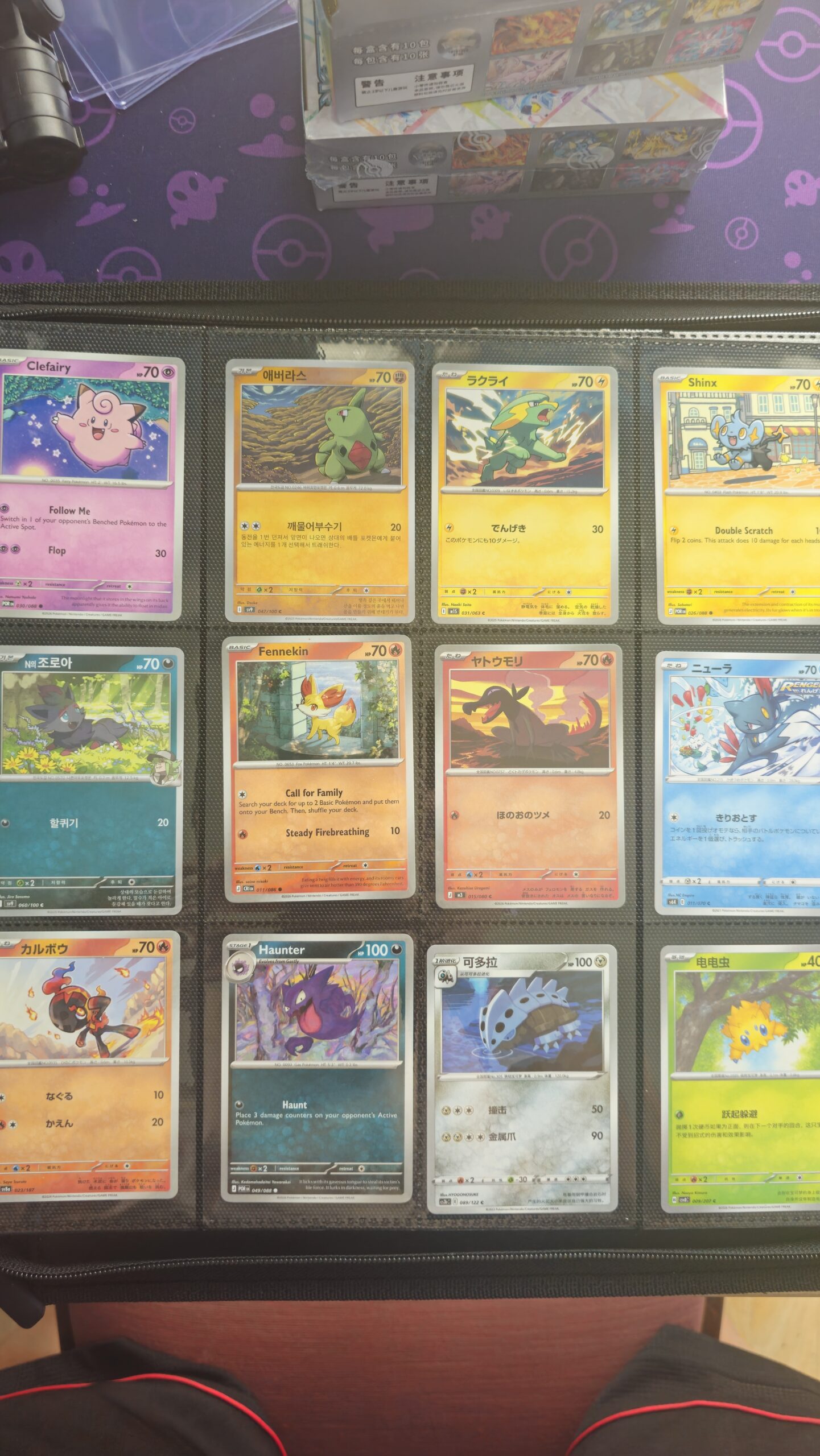

Building themed binder pages with Pokemon cards is incredibly fun and therapeutic. It gives you a newfound appreciation for every card you pull and the broader role it can play. In fact, I love incorporating commons, uncommons, and trainer cards wherever I can. Let’s take a look at my recent gen 1-9 Pokemon page and how it came together.
The Gen 1-9 Pokemon Binder Page
Inspiration for this idea came from someone else, so I will not take credit for it. A recent X post showed a put-together binder page with art rares and better rarity cards for the nine Pokemon generations. Moreover, it involved one’s favorite Pokemon from each generation. That gives page builders a ton of personalization options, as no two people like the same Pokemon across the board.
In my case, the challenge was multi-layered. More specifically, I set additional challenges for myself, although not all of them intended. As I collect Pokemon cards across 4 different languages, I wanted to add every one of them to the page. Moreover, my binder has 12 card slots, not 9, which is awkward when looking at gen 1-9 Pokemon. However, it also created an interesting opportunity for “wild card slots”.
The thing about using commons and uncommons is the sheer freedom you have. Even so, I have limited card stacks to choose from. After some quick Googling I eventually settled on a feasible list. The plan was made, the list is straightforward, and yet somehow, I still make an error. Rather than selecting Hisuian Sneasel for Gen 8, I include a normal one (which is Gen 2).
After someone pointed out the error to me, I went through my cards again. I am convinced I have the Hisuian version too. Wrong! Turns out it is a very cool Absol card. Colors are similar, but that’s where the good news ends. Swap in either a Grookey or Thwackey, problem solved. The Grass type also goes well with the rest of the gang.
Selecting Pokemon With Constraints
For the other slots, I made some interesting choices. There’s a Gastly, even though my favorite is Gengar. I also added a Joltik (as a wild card, along with Clefairy (gen 1), Larvitar (gen 2) , Electrike (gen 3), and Shinx (gen 4). Further entrants are Zorua (gen 5, Fennekin (gen 6), Salandit (gen 7), and Charcadet (gen 9). The final wildcard slot belongs to Lairon (gen 3).
The wildcard slots for the gen 1-9 Pokemon page are necessary. I can’t leave 3 empty card slots, and since they are wildcards, anything can go there. Want to use energy or trainer cards? Fine. Want some extra pokemon you love in there? Works too! Do you have art from mini tins you want to include? Knock yourself out!
Overall, the gen 1-9 Pokemon binder page brings me a lot of joy. Is it the prettiest looking? That depends on how you perceive it. The page is colorful, and varied. Yes, none of the cards are “wow” in terms of being an EX or better. They don’t need to be, as commons and uncommons have excellent artwork too.
That said, anyone looking to build their own gen 1-9 pokemon binder page has plenty of options. Don’t have a fancy looking version of the Pokemon you want? Slot in a common or uncommon as a placeholder, or as a permanent stay to give the page more character. Binder pages are very personal, and I just enjoy using common and uncommon cards as much as I can.
Final Thoughts
The main reason for making this page with cheap cards is affordability. LIfe has gotten very expensive, and shiny Pokemon cards are no exception. You can spend hundreds, if not thousands, on a gen 1-9 Pokemon binder page. Mine costs less than $5, yet that doesn’t make it better or worse than what anyone else wants to build.
One side effect to the page I made is the added “uniqueness” you discover afterward. Not only do we have a cohesive page color-wise, but something else stands out. Somehow, I ended up with cards created by 12 different artists. That makes the page priceless to me, as I think Pokemon TCG artists do not get nearly enough credit for their common and uncommon cards.
Go and build your own gen 1-9 Pokemon binder page. Be as creative as you can be, and then look closer at the cards themselves. Do you see new details? New artist names? Does a particular card trigger a specific memory? Cards are not just cardboard you put in a binder. They tell stories, either visually or emotionally. That feeling is worth protecting at all costs.
