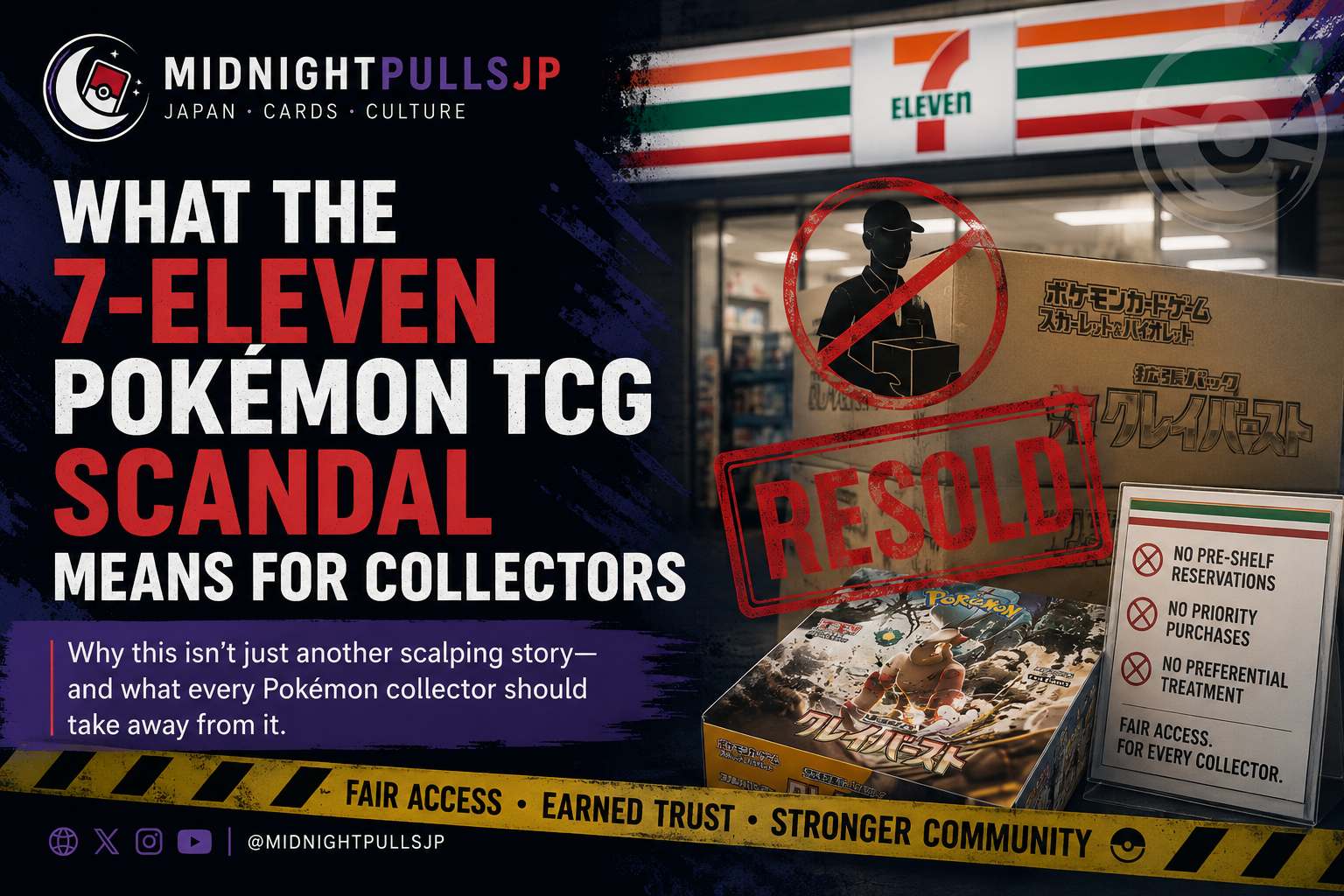

Most of you will have heard about the unusual Pokemon TCG stock dealing affecting Japan. More specifically, several 7-Eleven franchises were caught up in this mess, leading to some franchise contracts terminating early. As Pokemon collectors, however, we need to draw crucial conclusions from this ordeal.
The 7-Eleven Pokemon TCG Incident
Before we get into the details, I want to make some things very clear. Firstly, this is not an attack on 7-Eleven or its employees, as this is likely going on across other franchises too. Secondly, this issue is not isolated to Japan, and is probably a LOT worse in the Western world. With that out of the way, let’s get into the details.
The big news this week is the Pokemon TCG incident affecting 7-Eleven franchises across Japan. This was not an isolated incident involving a few products. Instead, it exposed a broader pattern of stock being diverted before it ever reached customers. Not only did franchise owners and employees withhold Pokemon TCG stock from the public, they also resold products at steep margins on the secondary market.
By actively controlling part of the supply and distribution of these products, many people successfully enriched themselves. Personnel set items aside in backrooms and/or bulk-purchased products before customers could buy it and/or sold them on marketplaces for steep profit.
Perhaps the most encouraging aspect of this entire situation is that the issue only came to light because collectors spoke up. Customer complaints, social media reports, and discussions within the community ultimately prompted an internal investigation. It is a reminder that collectors are not powerless. When enough people document suspicious practices and report them through the proper channels, even the largest retail chains are forced to take notice.
What Pokemon Collectors Need to Realize
Many people who have chased Pokemon products often blame The Pokemon Company for not printing enough products. However, this 7-Eleven development shows things are a bit different. In some cases, there may not have been a genuine product shortage at all. The products simply never reached the shelves in the first place.
Moreover, several collectors felt they were “unlucky”, missing out on lotteries, restocks, etc. Evidently, some of that was beyond their control, and had nothing to do with luck. Instead, several store owners and employees purposefully disrupted the flow of TCG products for personal gain.
This is very different from ordinary scalping practices. In the latter case, people buy up as much product displayed on the shelves as they can. In this case, however, the products were moved to backrooms BEFORE getting on the shelves.
The distinction matters because ordinary scalpers at least operate within the same buying conditions as everyone else. They may clear shelves within minutes, but the products were available for purchase, however briefly. When stock is diverted before release, collectors are denied the opportunity to compete on equal terms altogether. That is what makes this situation particularly frustrating from a fairness perspective.

Can 7-Eleven Regain Pokemon Collector’s Trust?
Despite the swift action being taken, it is impossible to undo the damage caused. Not just damage in terms of supply disruption, but also in broken trust. Many people will now think twice before setting foot in a 7-Eleven again in search of Pokemon TCG products. Then again, there are many alternative options available for those willing to explore them.
This does not mean 7-Eleven needs to be avoided completely, however. Despite the number of complaints against this chain, its stores, and employees regarding Pokemon TCG products, not every franchise location was involved. These incidents were conducted across specific locations, whereas many others operated normally.
For Pokemon collectors, it is a clear signal, though. Do not give out trust blindly when it comes to acquiring TCG products. Trust must be earned, even by chains like a 7-Eleven. Whether the new requirements put in place will be enough to remedy the situation, remains to be seen. It is a big step in the right direction, but there is no 100% guarantee this will not happen again.
Collector’s Conclusion
Collectors should also be careful not to let incidents like this create blanket assumptions. Thousands of retailers, franchise owners, and employees handle Pokemon TCG releases fairly every single day. Those businesses deserve continued support, especially when they actively enforce purchase limits and treat every customer equally. The actions of a minority should not overshadow those who are doing things the right way.
Next time you visit any store in Japan and see Pokemon products are sold out, know it isn’t you being unlucky necessarily. There is legitimately more demand for cards than printers can produce in a lot of cases.
The biggest lesson for Pokemon collectors is not to become cynical, but to become informed. Genuine shortages, overwhelming demand, and unfair retail practices can all exist at the same time. Understanding the difference helps us have more productive conversations about availability, support the retailers that treat customers fairly, and hold accountable those that don’t.
Incidents like this don’t define the hobby—but they do remind us why fairness, trust, and accountability matter.

[…] in the anime and movie. And while it is “cute”, it is still a bit of an “oddity” for most collectors and fans. It has also been downgraded from a “rare” card initially to a “common” card […]